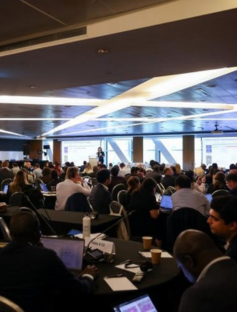

The inaugural Bhutan Climate Investment Forum in July 2026 marked an important milestone for this mountainous nation in the Eastern Himalayas: the operationalization of the Bhutan Climate Fund (BCF), now seeking private sector investment and buyer commitment.
Forum participants, which ranged from project developers to financial institutions and market intelligence firms, conveyed their interest in the following sectors for potential investment: methane reduction, renewable energy, waste management, and hydropower carbon credits.
The participants’ feedback is directly shaping the design of the BCF and underscores the growing interest of international buyers in Bhutan’s carbon credits. The Investment Forum’s success also demonstrates the country’s accomplishments. One of the world’s few carbon-negative nations, Bhutan is distinguished by the forests covering two-thirds of its land and the hydropower accounting for almost all electricity generation. It is also distinguished by the robust policy and institutional architecture developed by its policymakers, which ensures that the credits the country generates are high-quality and high integrity.
The World Bank Group (WBG) has been an important partner for Bhutan throughout its carbon market journey. Bhutan’s adoption of the Carbon Markets Rules in 2023 as part of the Second Green and Resilient Growth Development Policy Credit laid the foundation for enabling Bhutan's access to international carbon markets and the creation of the BCF. The launch of the Bhutan National Carbon Registry followed in 2023.
In 2025, recognizing the potential of carbon market participation in closing Bhutan’s climate financing gap, the WBG’s Country Climate and Development Report (CCDR) recommended the development of standard operating procedures (SOP) for the Bhutan Climate Fund – to facilitate existing projects with generated credits to move through the authorization process, and help project developers and local stakeholders build capacity to sustain an ongoing pipeline. The CCDR also identified market sounding with buyers as an essential requirement, noting that understanding buyer preferences and demonstrating credit quality were critical to scale up participation in carbon markets.
PMI support, delivered in 2025, was integral to Bhutan’s preparation for carbon market readiness. First, PMI assisted in the development of a comprehensive carbon market framework, which consolidated the policy, institutional, and technical standards into a single architecture.
The BCF’s SOP – now under development – is the second critical piece. Launched at COP28 and provided a legal mandate in 2025 through the Cabinet’s approval, the BCF is designed as a one-stop platform for Article 6 related activities, with three core functions: it aggregates smaller projects, acts as a structured intermediary between buyers and Bhutanese project proponents, and provides project development support to bring earlier-stage projects to market readiness. Central to the BCF's role is the collection and use of corresponding adjustment (CA) fees on all credits seeking authorization for use toward other countries' NDCs or other international mitigation purposes, charged by the Royal Government of Bhutan (RGoB) and used towards the country’s mitigation and adaptation priorities. Because Bhutan can no longer count for its own NDC a credit it has authorized and transferred, the CA fee is designed to compensate Bhutan for this direct opportunity cost and structured to progressively increase with the volume of credits authorized. As Bhutan exhausts lower-cost mitigation options, the marginal cost of maintaining its carbon-neutral status will rise over time.
In response to the CCDR’s recommendation for market sounding, Bhutan’s government has pursued a deliberate and phased engagement strategy with the private sector. An initial investor roundtable held in Singapore in 2025 introduced the BCF to a targeted audience of buyers and developers to test market appetite. At Innovate4Climate’s Carbon Markets Buyers' Forum in May 2026, Bhutan presented further progress on the BCF’s structure and governance alongside a ready project pipeline.
By bringing Bhutan's pipeline to international buyers and generating actionable insight on investor priorities, such forums are helping build the demand side for Bhutan’s high-quality credits. Operationalizing the BCF requires both procedural architecture and buyer engagement to bring it to fruition. The two are being developed in tandem.